Why Relaxing Together Is Actually Harder Than Relaxing Alone
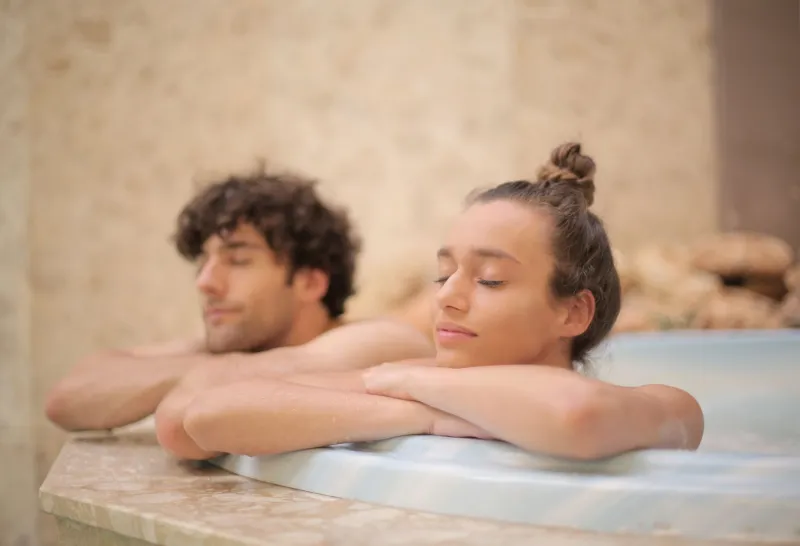
You've probably been there. You book a couples massage, you're genuinely excited, and then somewhere between the warm towels and the ambient forest soundscape, you realize you're not really with the person next to you. You're both just... separately relaxing. In the same room. To the same music. And somehow that feels lonelier than sitting at home alone with your earbuds in.
It's not your relationship. It's your nervous system — and the way wellness audio has been engineered almost entirely around solo consumption.
The Science of Listening in a Room With Someone Else
When you listen to sound alone, your brain is running a fairly contained operation. Your auditory cortex processes the input, your limbic system responds emotionally, and your autonomic nervous system starts to shift — heart rate slows, cortisol drops, breathing deepens. It's a clean, internal loop.
But add another person to the room? Suddenly your social brain wakes up.
"There's a whole layer of neural activity that kicks in the moment we're physically present with another person," says Dr. Lena Hargrove, a neuroscientist at the University of Michigan who studies social bonding and sensory environments. "We're constantly doing what researchers call 'social monitoring' — reading micro-expressions, tracking breathing patterns, sensing emotional states. Even in a spa, even with your eyes closed, that system doesn't fully shut off."
This creates a kind of neurological tug-of-war. The relaxation audio is trying to pull your brain into a parasympathetic state. Your social circuitry is simultaneously scanning the other person for cues. Unless both people are perfectly synchronized — and the audio is designed to facilitate that sync — you end up in a kind of limbo.
What Spa Owners Are Actually Noticing
Marcus Webb has owned a mid-sized day spa in Austin, Texas for eleven years. He started paying attention to this dynamic after a string of couples left their shared experiences reporting that they felt "close but not connected" — a phrase that kept coming up in his feedback forms.
"We were playing the same playlists we use for solo treatments," he says. "Tibetan singing bowls, rain sounds, the usual. And it occurred to me that none of that audio was relational. It wasn't designed to create a shared emotional experience. It was designed to help one person go inward."
Webb eventually hired a sound designer to build what he calls "dual-channel" playlists — audio that moves through dynamic phases rather than maintaining a flat ambient state. "There are moments of gentle swell, moments of quiet. Something that gives two nervous systems something to respond to together, almost like a shared heartbeat."
He says the difference in client feedback was immediate. "People started using the word 'connected.' That was new."
The Couples Therapist's Take
Dr. Sandra Okafor, a licensed couples therapist based in Atlanta, brings this up in sessions more than you might expect.
"Couples come in and say the spa day didn't feel bonding, and they feel guilty about that," she says. "Like they failed at relaxing together. But the reality is that most relaxation content is fundamentally solipsistic. It's asking you to go inside yourself. And intimacy requires going toward someone else."
The tension, she explains, isn't a personal failure — it's a design flaw. "When you're both listening to sounds meant to help you detach from the external world, you're both detaching from each other at the same time. That can feel isolating, even in a loving relationship."
Okafor now sometimes recommends that couples try conversational listening — choosing ambient audio together, actively discussing how it makes them feel, letting the sound be a shared subject rather than a shared escape.
Why Modern Wellness Audio Was Built for One
This isn't an accident. The wellness audio industry — apps, streaming platforms, spa playlists — grew up alongside the solo self-care movement. The cultural moment that produced bath bombs and solo spa Sundays also produced audio designed for individual nervous systems, individual headphone setups, and individual wind-down rituals.
The implicit message embedded in most relaxation content is: this is for you, just you, right now. That's powerful when you need to decompress alone. But it creates a strange friction when you try to use it as connective tissue between two people.
"There's a loneliness baked into modern wellness that we don't talk about enough," says Hargrove. "The entire infrastructure of relaxation has been optimized for isolation. Which makes sense given how fragmented and overstimulated our social lives are. But it means we've never really built the tools for collective calm."
What Actually Works When You're Listening Together
A few patterns are emerging from sound designers and spa owners who've started experimenting with shared audio environments.
Rhythm matters more than texture. Steady, pulsing sounds — certain types of binaural beats, slow rhythmic ocean waves — give two nervous systems something to entrain to simultaneously. Purely ambient, formless soundscapes don't offer that shared anchor.
Silence is connective. Several spa owners have found that building deliberate pauses into group audio — moments of near-quiet — actually increases the sense of shared presence. "You become aware of each other's breathing," says Webb. "That's incredibly intimate."
Conversation before listening helps. Okafor recommends that couples or friends spend two or three minutes talking before settling into shared audio. "You've established connection first. Then the sound deepens it rather than replacing it."
Choose music with emotional arc. Completely static ambient sound doesn't give shared listeners anything to experience together. Music that shifts — even subtly — creates shared emotional moments, micro-experiences you're both moving through at the same time.
The Deeper Question
Maybe the real issue is that we've gotten very good at relaxing alone and very unpracticed at relaxing with people. Wellness culture has handed us all the tools for a profoundly individual experience and called it self-care. Which it is. But somewhere in that optimization, the communal version of rest got left behind.
The spa without a shared sonic language is a little like a dinner party where everyone's wearing noise-canceling headphones. You're in the same space. You're both technically having a good time. But you're not really together.
That's worth fixing. And it turns out, the fix might start with paying attention to what's playing in the room.