Your Living Room as a Sound Sanctuary: Pro Spa Audio Secrets You Can Actually Use at Home
Walk into a well-designed spa and you'll notice something within about thirty seconds: the sound feels different. Not just quieter. Shaped. There's a quality to it that's hard to name — like the room itself is exhaling. That feeling isn't incidental. It's the result of deliberate acoustic design choices that most guests never consciously register.
The people behind those choices are sound designers — a specialty that's grown quietly alongside the US spa industry's boom. And increasingly, they're willing to talk about what they actually do. Turns out, a lot of it is surprisingly replicable at home, with no expensive equipment and no contractor required.
The First Secret: Silence Is an Active Ingredient
Most people think spa sound design is about finding the right music. It's not. It's about finding the right relationship between sound and silence.
"Silence is where the nervous system actually resets," says Jonah Ferris, a Portland-based acoustic consultant who has worked on spa environments across the Pacific Northwest. "Sound is the frame. Silence is the painting. Most home listeners get that completely backwards — they fill every second because silence feels uncomfortable, and then they wonder why they don't feel restored."
Professional spa designers deliberately build silence into their audio environments. A track might play for eight minutes, then fade to near-quiet for ninety seconds, then reintroduce a different layer. That pause isn't dead air. It's the moment the body actually integrates what it just experienced.
Try this at home: Instead of putting on a continuous ambient playlist, try the 8-1-8 structure. Eight minutes of sound, ninety seconds of intentional quiet (no checking your phone), eight more minutes of sound. Do this twice during a rest period and notice how differently you feel at the end compared to a straight twenty-four minutes of audio.
The Layering Technique Spas Use That Nobody Talks About
Here's something you might not realize about the ambient sound in a high-end spa: there's almost never just one thing playing. There are usually three to five distinct audio layers, each operating at a different frequency range and spatial position.
A typical professional spa soundscape might include:
- A low-frequency foundation — something with deep resonance, like a Tibetan bowl recording or low-end synthesizer tones, playing at barely audible volume. You feel it more than hear it.
- A mid-range texture — this is what most people would identify as "the music" — nature sounds, soft instrumentation, or ambient tones in the conversational frequency range.
- A high-frequency detail layer — gentle birdsong, distant water, subtle chimes. These keep the soundscape alive without demanding attention.
- Spatial variation — different sounds coming from different parts of the room, creating the sense that you're inside an environment rather than listening to a speaker.
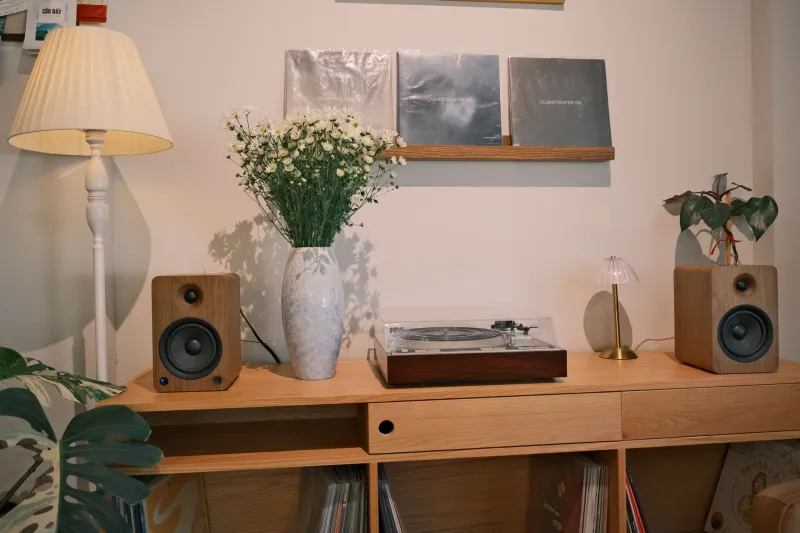
You can replicate this at home using nothing more than two devices and some intentional placement. Play a low, resonant ambient track on a Bluetooth speaker near the floor on one side of the room. Play a nature soundscape — rain, forest, ocean — from your phone or another speaker on the opposite side, slightly elevated. The brain perceives these as a unified environment rather than two separate sources, and that spatial dimension dramatically changes how immersive the experience feels.
Managing Acoustic Leakage (Without Renovating Your Apartment)
One of the biggest differences between a professional spa and your living room is acoustic isolation. Spas invest heavily in materials and construction that absorb outside noise — traffic, voices, HVAC hum — before it reaches the treatment room.
You can't replicate that without construction. But you can manage it.
"Soft surfaces are your best friend," says Ferris. "A room with a rug, curtains, upholstered furniture, and a few throw pillows absorbs sound reflections and outside noise significantly better than a hard-surface room. Most apartments with wood floors and bare walls are basically reverb chambers."
A few practical adjustments:
- Heavy curtains do double duty — they block outside sound and reduce internal echo. Blackout curtains, which many people use for sleep, happen to be excellent acoustic dampeners.
- A bookshelf full of books on a shared wall with a neighbor or street-facing wall acts as a surprisingly effective sound barrier.
- A white noise machine placed near the door — not to listen to, but as a sound buffer — can mask the irregular intrusion of hallway or street noise without adding another audio layer to your intentional soundscape.
The Scent-Sound Connection Spas Know About
This one might seem like it belongs in a different article, but bear with it: professional spa designers consistently pair specific audio environments with specific scents, and the combination creates a stronger relaxation response than either element alone.
The science here is real. Olfactory and auditory processing share neural pathways involved in emotional regulation, and when they arrive together consistently, they begin to condition each other. Eventually, the scent alone starts to trigger the relaxation the sound was producing — and vice versa.
At home, this means picking one scent — a candle, a diffuser oil, a linen spray — and pairing it with your specific relaxation audio session every time. Within two to three weeks of consistent pairing, that scent becomes a neurological shortcut to the calm state you're building.
Putting It All Together: A Simple Home Sound Protocol
You don't need a treatment room, a sound healing certification, or a four-figure speaker system. Here's a beginner home soundscaping setup that borrows directly from professional spa design:
- Prep the room. Close the door, draw the curtains, put a rolled towel at the base of the door if outside noise is an issue.
- Set up two audio sources in different positions and at different heights. Assign one to a low/resonant track, one to a nature or ambient texture.
- Choose your scent and light it before you start. Let the room fill for a few minutes before you settle in.
- Use the 8-1-8 silence structure. Set a timer for eight minutes, then give yourself ninety seconds of quiet, then another eight.
- End with two minutes of pure silence. No phone, no transition. Just let the room be still.
Do this three times a week for a month and you'll have trained your nervous system to drop into a relaxed state faster than any single app or playlist could manage on its own. That's not a wellness hack. That's just what the spas have known for years.